Live Nepal–Tibet Border Flood Updates: Trekking Routes Safety Status, and Helplines
URGENT SITUATION REPORT: Rasuwagadhi–Trishuli Flood Disaster
KATHMANDU — A catastrophic flash flood originating in the trans-Himalayan border corridor has swept down the Bhotekoshi and Trishuli river systems, leaving hundreds dead or unaccounted for, severing critical transit arteries between Nepal and China, and triggering a massive international search, rescue, and relief mobilization.
The disaster struck without warning around 8:40 AM on Wednesday, sending a wall of water, moraine, and debris tearing through border settlements, customs posts, and major trekking routes across Rasuwa, Nuwakot, Dhading, and Chitwan districts.
KEY FIGURES: SCALE OF DEVASTATION & CASUALTIES
- Confirmed Fatalities: Over 150 bodies recovered across Rasuwa, Nuwakot, Dhading, Chitwan, and Gyirong (Tibet).
- Missing Persons: Over 800 individuals officially reported out of contact, including riverside villagers, market traders, and hydro-project workers.
- Missing Security Personnel: 85 officers unaccounted for (44 Nepal Army, 28 Nepal Police, and 13 Armed Police Force personnel).
- Missing Tourists & Pilgrims: Between 380 and 600+ travelers currently out of contact across Langtang, Gosainkunda, and Kailash–Mansarovar pilgrim routes.
- Bridges Destroyed: 80 total crossings washed away (35 motorable road bridges and 45 suspension footbridges).
- Highway Damage: Approximately 40 km of paved roads heavily damaged or cut along the Pasang Lhamu Highway and sections of the Prithvi Highway corridor.
- Hydropower Disruptions: Roughly 430 MW of power generation knocked offline, including Chilime, Rasuwagadhi, Trishuli 3A, Trishuli 3B Hub, and Devighat stations.
CAUSE OF THE SURGE: GEOLOGICAL COLLAPSE VS DAM RUMORS
- Addressing initial rumors alleging an intentional dam release or structural breach on the Chinese side, the Chinese Embassy in Nepal explicitly refuted those claims as baseless, confirming the tragedy was a natural geological catastrophe.
- Satellite assessments and hydrological analyses from ICIMOD (International Centre for Integrated Mountain Development) confirm that the deluge was triggered by a high-altitude rock-and-ice avalanche roughly 20 km northeast of the border.
- A seismic event triggered a massive glacial collapse into the Lhende Khola riverbed, creating a 50-meter-high temporary moraine barrier lake that rapidly breached under intense hydraulic pressure, discharging an estimated 20 million cubic meters of water and heavy debris down the gorge.
BILATERAL LEADERSHIP & ON-SITE INSPECTIONS
Nepal Prime Minister’s Field Inspection: Prime Minister Balendra Shah traveled by road to the flood-ravaged downstream corridor in Bidur and Nuwakot for an immediate on-site inspection. Accompanied by cabinet ministers, the Prime Minister assessed physical destruction along the Trishuli, Betrawati, and Devighat riverbanks, visited injured survivors receiving treatment, and directed security agencies and local administrations to accelerate relief delivery and rapid bridge restoration on a war footing.
Chinese Premier at Border Zone: Chinese Premier Li Qiang arrived directly in Gyirong County to inspect the devastated border checkpoint, oversee frontline rescue operations, and direct a Level I emergency response. President Xi Jinping issued urgent directives prioritizing life preservation and continuous monitoring of upstream barrier lakes.
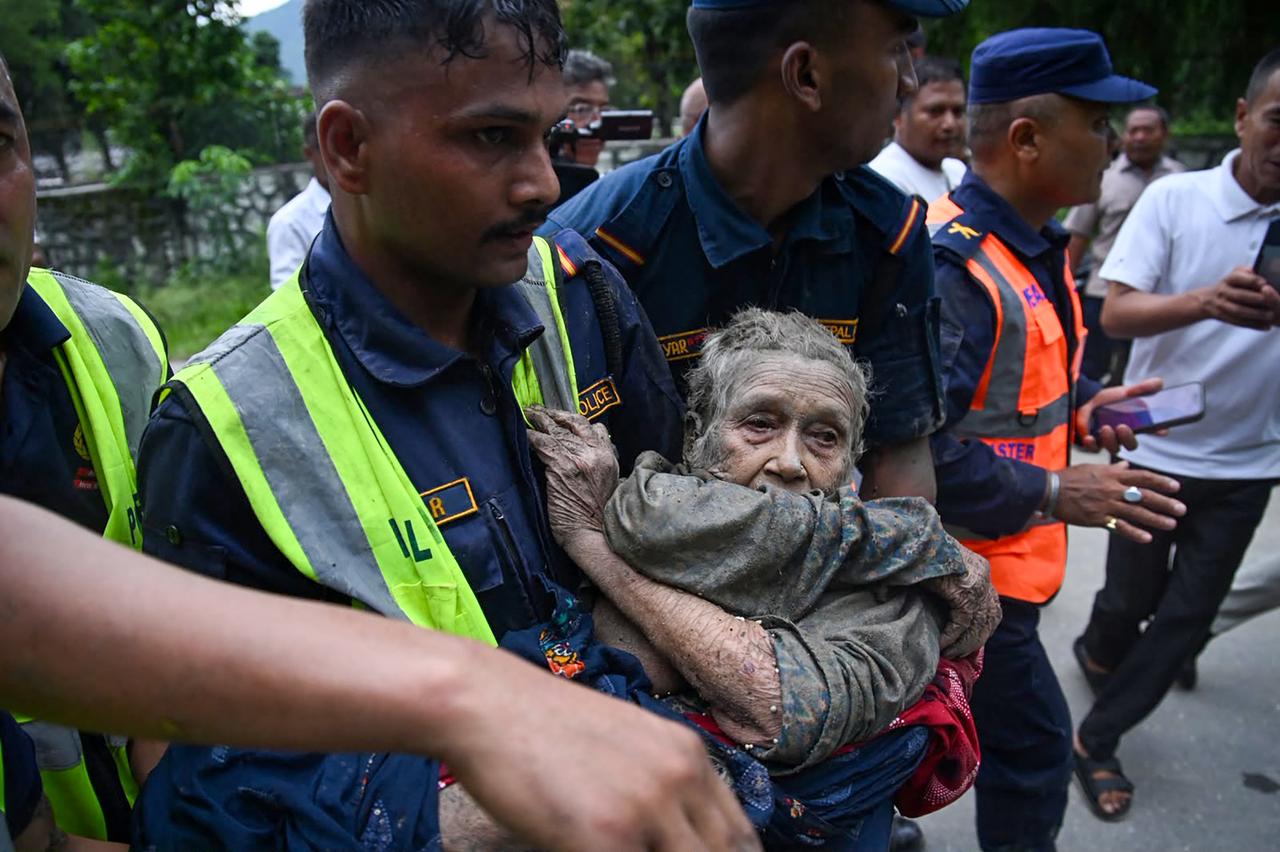
Nationwide Emergency Mobilization: The Nepal Army, Armed Police Force, and Nepal Police have deployed hundreds of ground personnel alongside military and civilian helicopters to airlift stranded survivors and deliver critical emergency rations.
INTERNATIONAL RELIEF & GLOBAL DIPLOMATIC AID
India: Prime Minister Narendra Modi reached out to Nepalese leadership, offering disaster management, specialized medical teams, and engineering support. Consular desks are actively coordinating tracing for over 100 Indian pilgrims undertaking the Kailash–Mansarovar route.
China: Deployed specialized engineering and heavy-machinery units (including China Anneng) to clear border debris, stabilize upstream channels, and provide direct logistical relief along the border corridor.
Western & Asian Consulates: Embassies and foreign ministries from the United States, Australia, Malaysia, South Korea, Ukraine, the United Kingdom, and Canada have established emergency coordination desks with the Nepal Tourism Board (NTB) and Tourist Police to trace and evacuate missing trekkers and technical personnel.
Humanitarian & Multilateral Agencies: United Nations disaster coordination units, Red Cross/Red Crescent societies, and international disaster NGOs are mobilizing water purification units, satellite emergency communication arrays, temporary shelters, and trauma care packs for displaced communities.
CRITICAL TRAVEL ADVISORY & EMERGENCY HELPLINES
All trekking, mountaineering, and overland transit along the Langtang Valley, Gosainkunda, Tamang Heritage Trail, and Rasuwagadhi border crossings remain strictly suspended until structural integrity checks and temporary bailey bridges can be completed.
Nepal Tourism Board Emergency Hotline: 1144 / Toll-Free: 1234
Tourist Police Headquarters: +977-9851289445
National Disaster Risk Reduction & Management Authority (NDRRMA): 1155
- The Kathmandu–Pokhara route (Prithvi Highway) remains blocked and restricted following the Bhotekoshi–Trishuli flash flood surge . The Kathmandu Valley Traffic Police Office halted outbound public and heavy vehicular transport exiting the Valley toward Pokhara, Chitwan, Gorkha, and western destinations. Corridor Damage: Severe scouring, debris deposits, and localized washouts occurred along vulnerable riverside stretches between Galchhi, Malekhu (where the Furke Khola bridge structure was swept away), and the Muglin gorge section.
OPERATIONAL & TEAM SAFETY UPDATE: GOOD KARMA TREKKING
We would like to reassure all our clients, international partners, families, and well-wishers that all Good Karma Trekking staff, guides, field crew, and team members are completely safe and accounted for.
None of our team members or active trekking groups were involved or caught in the disaster zone. Our operations team remains on standby and actively coordinates with tourism authorities and local relief efforts.